
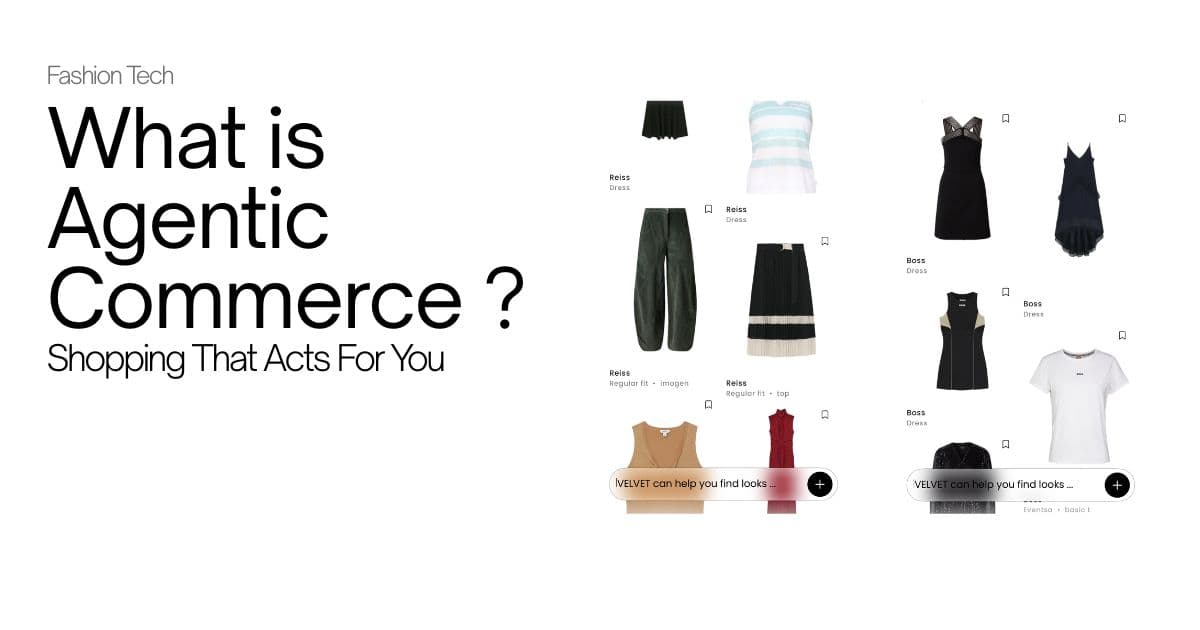
What is Agentic Commerce? Shopping That Acts For You
Agentic commerce is AI that shops on your behalf — understanding your taste, browsing for you, and making decisions without constant input. Here is what it means for fashion.
Agentic commerce is shopping software that does not only answer questions—it takes actions on your behalf inside guardrails you set: narrowing a million SKUs, comparing silhouettes, holding budget and taste as state until a shortlist is worth your attention. You ask for a jacket for a rainy Berlin weekend with a hard spend cap; the system returns three shoppable options, explains why each fits, and iterates without you retyping filters—that is delegated intent instead of a search box, and at Velvet we are building that loop for fashion through dialogue-first discovery today, a Digital Double for honest preview, and a persistent agent roadmap that remembers what you already own.
Mainstream definitions (for example IBM Think) emphasize agents that research, compare, and complete purchases within permissions—not just chat. That same IBM piece summarizes Institute for Business Value work reporting that 45% of consumers already use AI for part of the buying journey—one reason the category is heating up while labels still compete. Our glossary entry keeps the definition tight; what is virtual try-on covers the mirror side of trust—delegation fails if the preview still lies about fit.
What makes commerce "agentic"?
Three properties separate real agency from smarter search.
First, preference context—not just queries. A classic site remembers your last keyword; an agentic layer remembers that you hate visible logos, that you run cold, that “smart casual” for you means structured shoes, not sneakers. Example: you mention a wedding in Lisbon; it weights linen blends and lighter palettes without you spelling “summer fabric.”
Second, proactive action. Reactive help says “here are 400 results.” A true agent prunes, ranks, and sequences—surface a return-policy caveat, suggest a belt because it inferred a gap, flag a hem risk before checkout. Example: after trousers hit the cart, it offers length alternatives informed by your height in profile—not after the wrong inseam ships.
Third, reduced decision fatigue. Infinite scroll sold us on false abundance; this model bets a tight shortlist with reasoning beats page twenty of near-duplicates. Example: three black knits, each with a one-line “why not the others” tied to your stated aesthetic—no twenty-tab archaeology.
At Velvet, we think taste amnesia turns agents into autocomplete with swagger. Fashion raises the bar: the system has to sound like it gets you, not like it skimmed a trend PDF.
Agentic commerce in fashion: why this category is first
Fashion is not spec-driven the way electronics are. Apparel is taste, silhouette, occasion, identity—and catalogs that span a million plausible items break keyword search faster than almost any other vertical. Conversational commerce was the warm-up: natural language as input. Agentic commerce is the main event: language plus action across that haystack.
Discovery is the bottleneck. Filters assume you know the vocabulary of your own style; most people know how they want to feel. Delegated shopping maps feeling to inventory—“sharp but not corporate,” “quiet luxury but actually affordable.” In that frame, the agentic layer is the product, not a sidebar feature—and agentic commerce earns its proof in fashion before calmer, spec-heavy categories because taste resists keywords.
Conversational commerce also pairs naturally with virtual try-on: the agent proposes; the Digital Double proves. Fashion is leading this wave because pain stacks—under-searchable taste plus high return risk—exactly where proactive browsing plus body-grounded preview compounds.
Who is building agentic commerce right now
Stitch Fix earned its reputation on human stylists plus data—less “LLM agent,” more hybrid logistics and curation at scale. Honest strength: shoppers delegate taste when the box feels personal. The gap versus fuller delegation is real-time iteration inside one session and transparent “why this piece” across an open web of brands, not only a fixed assortment.
Amazon Rufus and similar copilots sit on infinite selection and fulfillment muscle. Honest strength: breadth and speed when the model narrows ASINs. The fashion risk is homogenization: systems that optimize purely for conversion can flatten taste into “people also bought” gravity wells.
Google Shopping AI experiments aim to make intent portable across merchants. Honest strength: comparison and open-web discovery. The open problem is continuity—does the assistant remember you next Tuesday, or does every session cold-start?
[Daydream] is the closest consumer-scale cousin in pure fashion right now: a chat-native shopping layer built to search and rank across a massive multi-brand catalog using conversational prompts, visual context, and frontier plus specialized models—conversational commerce at runway-to-mall breadth. At public launch it emphasized a style passport, daily inspiration, and collections while sending checkout to partner retailers (Fortune, TechCrunch). That is a real product breakthrough: most people experience it as “finally, search that speaks taste.” We would still draw a line to the fuller agentic bar we use here—a single thread that combines months-long wardrobe context, standing budget rules, and body-grounded try-on on every shortlist—not only rich discovery inside a strong profile. Daydream proves the demand; the next increment is memory plus action plus proof on the body.
A few other newer startups are orbiting the same problem from different angles—worth watching as the category crystallizes. Coveti blends luxury marketplace inventory with occasion-led styling prompts (they have leaned into “agentic” language in marketing); strength is curated multi-boutique selection, not open-web scale. Fayno pitches an AI stylist that converses, takes visual references, and hands off to existing retailer checkouts—useful where the bottleneck is decision quality, not warehouse robotics. GoShopMe (with its “ShAI” assistant) pushes text- and voice-led shopping with inspiration uploads and chat-mediated checkout—early traction is a signal that shoppers want delegation, even as the durable moat (data, try-on, returns integration) is still being built. None of these yet bundle the whole stack we care about—taste dialogue, persistent context, and a Digital Double—but they are pulling the thesis from keynote slide to shipping product.
Shopify Sidekick represents agentic commerce from the merchant’s chair—copilots that help stores write copy, tweak merchandising, and answer ops questions. Honest strength: it makes independent brands faster at running the shop. The shopper-facing gap for fashion is still taste delegation across brands with a body-accurate preview—not only admin efficiency inside one storefront.
Velvet is the identity and intelligence layer for fashion on the path to agentic commerce: one style graph, one Digital Double, conversational discovery today, and a persistent agent that will know your wardrobe, your budget, and your aesthetic. That matches how we talk on the homepage: we are not bolting a chat bubble onto a catalog—we are treating delegation of taste as the core loop.
The difference between a chatbot and an agent
Chatbots respond; agents act. A chatbot waits for the next message. An agent in the agentic commerce sense maintains a running objective—help this person find a rooftop dinner outfit under €150 with no logos—and executes subtasks toward it.
Chatbots skew stateless even when vendors claim memory: each turn risks amnesia unless engineered. Agents carry state—budget ceilings, hard nos (“no shearling”), soft preferences (“Japanese denim bias”), and artifacts from earlier in the session (pieces already ruled out).
LLMs made language cheap; production-grade agents still need scaffolding—tool use, catalog APIs, policy filters, and UI that shows what happened, not only what was said. Trust wants receipts: “I dropped these twelve SKUs because they broke your logo rule.” That transparency keeps the category legible to regulators and to shoppers who treat black boxes as red flags.
What agentic fashion shopping looks like in practice
Scenario: “I need something for a rooftop dinner in Berlin, no logos, budget €150.”
Traditional search: you translate into keywords—“shirt black minimal”—then price-filter, then open a dozen tabs, then guess which fabric reads “evening” on a roofline, then bounce when shipping math bites. Nothing in that flow is wrong—it is just un-agentic: you carry all the cognitive load agentic commerce is meant to absorb.
Agentic response: one clarifying question if needed (jacket or not, fit bias), then three shoppable looks with rationale: A, a matte camp-collar that reads clean at golden hour; B, a tonal knit set that leaves room under budget for shoes; C, a statement trouser plus plain tee because your history suggests you like proportion play. Each opens on your Digital Double so length and shoulder read true; the assistant notes merchants that still hit your delivery window.
That is agentic commerce in one breath: preference compression, proactive narrowing, output shaped like a decision—not a paragraph of vibes. Conversational commerce supplied the language; the agent supplies the shortlist and the next step.
At Velvet, we believe the version of this that wins will feel less like “AI shopping” and more like a sharp friend who remembers what you wore last time—and would never burn your evening on irrelevant SKUs. Agentic commerce is young as a label; the behavior it names is what impatient, taste-heavy shoppers already wanted before the vocabulary caught up.
Keep reading
How to choose an outfit planner app
The best outfit planner apps make everyday what-to-wear decisions easier by combining wardrobe context, outfit building, and shopping support.
2 min read ·
What does an AI stylist actually do?
An AI stylist helps translate your taste, occasion, and budget into more relevant outfit and product suggestions.
2 min read ·
What is a digital closet app?
A digital closet app helps you organize saved clothing, outfit ideas, and shopping context so future decisions get easier.
2 min read ·